How To Sync Real Time Multiplayer Server State Across Edge Nodes?
You just deployed your multiplayer game across five edge nodes spread around the globe. Players in Tokyo, Berlin, and New York are all in the same match. Then it happens. A player on one edge node picks up an item that another player on a different node already grabbed two milliseconds ago. Two players now own the same item. The game state has split.
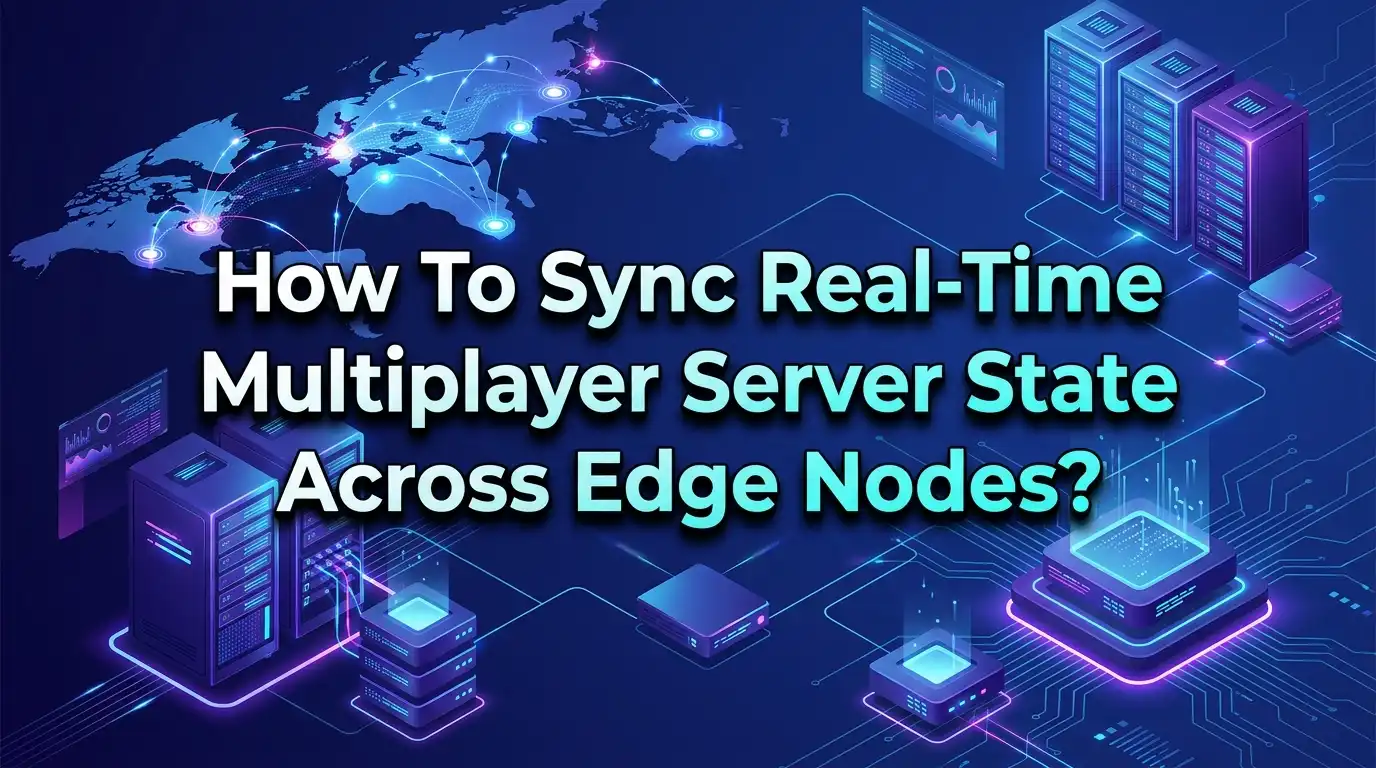
This is the core challenge of syncing real time multiplayer server state across edge nodes. As multiplayer games push closer to players through edge computing, the old single server model breaks down. You need a way to keep game state consistent across multiple distributed nodes without adding the very latency you tried to eliminate.
This guide walks you through the actual techniques, architectures, and strategies that solve this problem. You will learn how to pick the right consistency model, handle conflicts, reduce bandwidth, and build a sync pipeline that keeps your game playable at scale. Every section gives you a concrete approach you can apply today.
Key Takeaways
- Edge nodes bring game servers closer to players and cut latency, but they create a state synchronization problem that demands careful architectural planning and the right conflict resolution strategy.
- Delta state synchronization is the most bandwidth efficient approach for syncing across edge nodes because it sends only the changes since the last update instead of the full game state every tick.
- Conflict Free Replicated Data Types (CRDTs) allow multiple edge nodes to accept writes independently and merge state automatically without a central coordinator, making them ideal for certain game state categories.
- A hybrid consistency model works best for most multiplayer games, where you apply strong consistency for critical actions like combat hits and inventory changes, and eventual consistency for less sensitive data like player position interpolation.
- Pub/sub messaging layers and event streaming platforms such as Apache Kafka or similar tools provide a reliable backbone for propagating state changes between edge nodes with ordering guarantees.
- Client side prediction, server reconciliation, and entity interpolation remain essential even in an edge distributed architecture because they hide the latency that still exists between edge nodes and between nodes and clients.
Why Edge Nodes Change the Multiplayer Sync Problem
Traditional multiplayer games use a single authoritative server. Every player connects to it. The server processes all inputs, updates the game state, and sends results back. This model is simple. It keeps one source of truth. But it has a fatal flaw: players far from the server experience high latency.
Edge computing solves this by placing game servers at points of presence near player clusters. A player in Singapore connects to a Singapore edge node instead of a server in Virginia. Round trip time drops from 200ms to 20ms. The game feels snappy and responsive.
But now you have multiple nodes, each handling a portion of the player base. These nodes must agree on what the game world looks like. If Player A on Node 1 destroys a wall, Player B on Node 2 must see that wall disappear at nearly the same moment. The state must flow between nodes fast enough that the game feels unified.
This is fundamentally different from the classic single server setup. You are no longer just replicating state from server to clients. You are replicating state from server to server, where each server may be accepting and processing player inputs concurrently. The distributed systems challenges of consistency, ordering, and conflict resolution now sit right in your game loop.
Understanding Consistency Models for Game State
Before you pick a sync strategy, you need to decide how consistent your game state must be across edge nodes. Distributed systems offer a spectrum of consistency models, and each comes with tradeoffs.
Strong consistency means every edge node sees the same state at the same time. This is the gold standard for correctness but the worst for latency. Achieving strong consistency across geographically distributed nodes requires coordination protocols that add round trips between nodes before any state update can be confirmed. For a game server ticking at 20 to 60 times per second, this overhead can be unacceptable.
Eventual consistency means all edge nodes will converge to the same state given enough time, but they may temporarily disagree. This model is faster because nodes can process inputs locally and propagate changes asynchronously. The tradeoff is that two nodes might briefly show different versions of the truth.
The practical answer for most games is a hybrid model. You classify your game state into tiers. Critical state like health, score, and item ownership gets strong consistency through a designated authority. Transient state like player position and animation gets eventual consistency with prediction and interpolation to smooth over discrepancies. This split lets you protect the data that matters most while keeping your game loop fast.
Choosing an Authority Model for Distributed Edge Nodes
Every piece of game state needs an owner. Someone must have the final say on what the truth is. In a distributed edge architecture, you have several authority models to choose from.
The global authority model designates one node (or a central service) as the single source of truth for all critical state. Other edge nodes forward critical actions to this authority and wait for confirmation. This is the simplest to reason about. It prevents conflicts entirely for critical state. But it reintroduces latency for players whose edge node is not the authority.
The partitioned authority model assigns ownership of different state partitions to different edge nodes. For example, Node 1 owns the state for Zone A of the map, and Node 2 owns Zone B. Players interacting within a zone get low latency because their local edge node is authoritative. Conflicts only arise at boundaries, when a player moves between zones or interacts across zone lines. This model scales well for large game worlds with natural spatial divisions.
The distributed consensus model uses algorithms like Raft to let edge nodes agree on state changes without a fixed leader. This offers fault tolerance and avoids single points of failure. However, consensus protocols add latency proportional to the number of nodes and the network distance between them. They work best when you have a small number of edge nodes (three to five) and can tolerate slightly higher confirmation times.
Most production systems combine partitioned authority with a lightweight global coordinator for cross partition actions. This gives you the speed of local authority with a fallback for edge cases.
Using Delta State Synchronization Between Nodes
Sending the full game state between edge nodes on every tick is wasteful. A game with thousands of entities can have megabytes of state data. Transferring all of it 20 to 60 times per second across multiple intercontinental links will choke your bandwidth.
Delta state synchronization solves this. Instead of sending the entire state snapshot, each edge node sends only the changes since the last acknowledged sync point. If only 12 entities moved and 1 item was picked up, you send data for those 13 changes instead of the full state of 5,000 entities.
To implement delta sync, you maintain a version number or sequence counter for each state element. When an element changes, you tag it with the current tick number. At sync time, you compare each element’s tick number against the last tick the receiving node acknowledged. You send only elements with newer tick numbers.
Delta compression can reduce bandwidth even further. Instead of sending the new value of a field, you send the difference between the old and new value. For fields like position coordinates that change by small increments each tick, the delta values are small and compress well.
You also need a mechanism for full state snapshots at intervals. If a new edge node joins, or if delta updates accumulate errors, a fresh snapshot resets the baseline. A common pattern is to send a full snapshot every few seconds while sending deltas every tick. This keeps the system self correcting.
Implementing CRDTs for Conflict Free State Merging
When two edge nodes modify the same piece of state at the same time, you get a conflict. CRDTs (Conflict Free Replicated Data Types) are data structures that resolve this automatically. They guarantee that any two nodes that have received the same set of updates will converge to the same state, regardless of the order the updates arrived.
There are several CRDT types useful for games. G Counters (grow only counters) work for score tracking. Each node increments its own counter, and the total is the sum of all counters. PN Counters add decrement support by maintaining separate increment and decrement counters. LWW Registers (Last Writer Wins) store a single value and resolve conflicts by keeping the write with the latest timestamp. This works for properties like a player’s current weapon or status effect.
LWW Element Sets handle inventories and collections. Each add or remove operation is tagged with a timestamp, and the latest operation for each element wins. This prevents the “two players grab the same item” problem as long as your clocks are reasonably synchronized.
CRDTs are not free. They add memory overhead because they store metadata for conflict resolution. They also work best for commutative operations where order does not matter. For game actions where order is critical (like a sequence of damage events determining who died first), CRDTs alone are not enough. You need an authoritative arbiter for those cases.
Recent research, including work on CRDT based game state synchronization in VR environments, confirms that CRDTs can handle real time multiplayer sync effectively when paired with techniques like dead reckoning for prediction.
Building a Pub/Sub Messaging Layer for State Propagation
Your edge nodes need a communication backbone. A publish/subscribe messaging layer provides an efficient and decoupled way to propagate state changes between nodes.
Each edge node publishes its state deltas to channels organized by game session, zone, or entity type. Other edge nodes subscribe to the channels they need. A node responsible for Zone A subscribes to updates from zones that border Zone A. It does not need updates from a zone on the other side of the map.
This channel based approach gives you fine grained control over data flow. You reduce unnecessary traffic by letting each node receive only the state it cares about. It also decouples the nodes from each other. A node does not need to know the addresses of all other nodes. It just publishes and subscribes.
For the messaging infrastructure, you need low latency, high availability, and message ordering within channels. Event streaming platforms like Apache Kafka provide ordering within partitions and durable message retention. This means if a node goes down and comes back up, it can replay missed messages from the stream and reconstruct the current state.
The pub/sub layer also enables a useful architectural pattern: backend consumer workers that reduce the event stream into database snapshots. These workers subscribe to all state change events, apply them sequentially, and write the resulting state to persistent storage. This keeps your edge nodes focused on real time processing while background workers handle durable storage.
Handling Cross Node Player Interactions
The hardest sync problem occurs when players on different edge nodes interact directly. One player on Node 1 shoots at a player on Node 2. Both nodes have slightly different views of where each player is. Who decides if the shot hits?
The most common solution is interest management with authority handoff. When two players come within interaction range, the system designates one node as authoritative for that interaction. The other node forwards the relevant player’s input to the authoritative node for resolution.
Another approach is server side hit validation at a central coordinator. Both edge nodes send their local view of the interaction to a lightweight central service. This service applies authoritative game rules, determines the outcome, and broadcasts the result to both nodes. The added round trip to the coordinator adds latency, but it guarantees fairness.
For less critical interactions, you can use optimistic execution with reconciliation. Both nodes process the interaction locally and immediately show the result to their players. In the background, they exchange their interaction data. If the outcomes match, no correction is needed. If they disagree, a reconciliation protocol picks the authoritative result and corrects the other node. The correction might cause a brief visual glitch, but for many game types this is acceptable.
The key is to classify interactions by importance. A player trading an item requires strong consistency. A player dealing area of effect damage to distant targets can tolerate eventual consistency. Match the sync strictness to the gameplay impact.
Client Side Prediction and Server Reconciliation at the Edge
Even with edge nodes close to players, latency still exists. A player pressing a movement key cannot wait 20ms for the edge node to respond before seeing their character move. Client side prediction makes the game feel instant.
The client simulates the effect of the player’s input locally before the server confirms it. The player presses forward, and the client immediately moves the character forward based on the same physics the server uses. When the server’s authoritative state arrives, the client compares it with its prediction. If they match, nothing changes. If they differ, the client corrects its state to match the server.
Server reconciliation is the correction step. The client stores a buffer of its recent inputs along with the predicted states they produced. When the server sends back its authoritative state tagged with the last processed input, the client replays all inputs issued after that point on top of the server’s state. This produces a corrected current state that accounts for both the server’s authority and the player’s recent actions.
In an edge distributed architecture, this process works the same way, but you must ensure the edge node applies inputs in a consistent order. If the edge node receives inputs from 50 local players plus state updates from other edge nodes, it must merge these into a single coherent update sequence. Timestamping inputs and using a priority queue sorted by timestamp is a practical approach.
Entity interpolation handles the other side of the problem. Other players’ positions are rendered slightly in the past, using real position data from the server. This smooths out the gaps between updates and avoids the jerky teleportation that raw position updates would cause.
Synchronizing Clocks Across Edge Nodes
Most sync techniques depend on timestamps. Delta ordering, LWW conflict resolution, and input sequencing all assume that the clocks on different edge nodes roughly agree. If they do not, your sync logic breaks.
NTP (Network Time Protocol) provides millisecond accuracy clock synchronization and is the baseline for most distributed systems. For game servers, millisecond accuracy is usually sufficient. Run NTP daemons on all edge nodes and ensure they sync against the same set of reference servers.
For tighter requirements, you can implement a custom clock sync protocol between your edge nodes. Each node periodically exchanges timestamp pings with other nodes and calculates the clock offset. This gives you a logical clock offset table that you apply to incoming messages. When Node 2 receives a message from Node 1, it adjusts the timestamp by the known offset between their clocks.
Logical clocks like Lamport timestamps or vector clocks offer an alternative that does not depend on physical time at all. They track the causal ordering of events. If event A happened before event B, the logical clock guarantees A gets a lower timestamp than B, even if the physical clocks disagree. Vector clocks extend this to track causality across multiple nodes independently.
For most multiplayer games, NTP plus a small tolerance window (accepting events within a few milliseconds of each other as concurrent) works well. Reserve vector clocks for scenarios where exact causal ordering of cross node events is essential.
Reducing Bandwidth With Interest Management
Not every edge node needs every piece of game state. A player in the northwest corner of a game map does not need real time updates about entities in the southeast corner. Interest management filters the data each node receives.
Spatial partitioning is the most common technique. Divide the game world into zones or cells. Each edge node subscribes to updates for the zones its players can see or interact with. When a player moves to a new zone, the node subscribes to the new zone’s channel and unsubscribes from the old one.
Relevance filtering adds another layer. Within a zone, not all entities matter equally to every player. An entity 500 meters away can receive updates at a lower frequency than one right in front of the player. You send full rate updates for nearby entities and reduced rate updates for distant ones. This technique, sometimes called Level of Detail for networking, can cut bandwidth by 50% or more in large game worlds.
Prioritized update queues let you handle bandwidth spikes gracefully. If too many entities change in a single tick, you prioritize updates for entities closest to players or most relevant to gameplay. Less important updates get deferred to the next tick. The player sees what matters first, and the rest fills in within a frame or two.
These techniques combine to keep inter node traffic manageable even as your game world and player count grow. Without interest management, bandwidth scales linearly (or worse) with the number of entities and nodes. With it, bandwidth scales with what each node actually needs to know.
Handling Node Failures and State Recovery
Edge nodes can fail. Network links between nodes can drop. Your sync architecture must handle these scenarios without losing game state or crashing the match.
State checkpointing is your safety net. Each edge node periodically saves a full snapshot of its authoritative state partition to durable storage (a database or distributed file system). If the node crashes and restarts, it loads the latest checkpoint and replays events from the messaging layer since that checkpoint. This is why durable message retention in your pub/sub layer matters. If your event stream retains messages for the last 60 seconds, your node can recover from any outage shorter than that.
Failover to a backup node provides continuity for players. Run a passive backup for each edge node that subscribes to the same state channels. If the primary node fails, the backup promotes itself to active, loads the latest state, and begins accepting player connections. Players experience a brief reconnection delay but do not lose the match.
Graceful degradation is another strategy. If the link between two edge nodes drops, each node continues running independently with its local players. Cross node interactions are temporarily disabled or resolved with best guess logic. When the link recovers, the nodes reconcile their states. For games with natural spatial boundaries, this works well because most player interactions are local.
Design your sync protocol to be idempotent. If a state update message is delivered twice (which happens during failover), applying it twice should produce the same result as applying it once. This eliminates a whole class of bugs during recovery.
Testing and Monitoring Distributed State Sync
Building the sync system is half the battle. Validating that it works under real conditions is the other half. Distributed systems fail in surprising ways, and multiplayer sync bugs are often invisible until thousands of players expose them.
Chaos testing intentionally introduces failures into your edge network. Kill nodes, drop packets, add artificial latency between nodes, and corrupt messages. Then verify that the game state converges correctly after the disruption. Tools that simulate network partitions and latency spikes help you find edge cases before your players do.
State divergence monitoring compares the game state across edge nodes in real time. At regular intervals, each node computes a hash of its critical state and shares it with a monitoring service. If two nodes that should agree produce different hashes, you have a divergence bug. Catching divergence within seconds prevents it from cascading into visible gameplay issues.
Replay and audit logging records every state change event with its timestamp, source node, and sequence number. When a bug report comes in, you can reconstruct exactly what happened across all nodes. This is essential for debugging race conditions and ordering issues that are impossible to reproduce in a development environment.
Latency dashboards track the time between a state change on one node and its application on another. If inter node sync latency spikes above your tolerance threshold (say, 50ms), an alert fires. This lets your operations team respond before players notice degradation.
Step by Step Guide to Building Your Sync Pipeline
Here is a practical sequence for implementing edge node state synchronization from scratch.
Step 1: Define your state schema. List every piece of game state and classify it as critical (needs strong consistency) or transient (tolerates eventual consistency). Critical state includes health, inventory, match score, and game phase. Transient state includes positions, velocities, and animation states.
Step 2: Choose your authority model. For most games, use partitioned authority where each zone has an owning edge node. Add a lightweight central coordinator for cross zone critical actions.
Step 3: Implement delta serialization. Build a system that tracks changed fields per entity per tick and serializes only the deltas. Use a binary format like FlatBuffers or MessagePack for compactness.
Step 4: Set up your messaging backbone. Deploy a pub/sub system with channels per zone and per session. Ensure message ordering within each channel. Configure message retention for at least 60 seconds to support node recovery.
Step 5: Implement CRDTs for shared mutable state. Use LWW registers for single value properties and PN counters for additive values. Test merge behavior under concurrent writes from multiple nodes.
Step 6: Build the client prediction and reconciliation loop. The client predicts locally, the edge node confirms authoritatively, and the client reconciles on mismatch. Add entity interpolation for remote players.
Step 7: Add interest management. Filter outbound updates by spatial relevance. Implement priority queues for bandwidth capping.
Step 8: Implement checkpointing and failover. Save snapshots every 5 to 10 seconds. Test recovery by killing nodes during active matches.
Step 9: Deploy monitoring. Track state hashes, inter node latency, and event throughput. Set alerts for divergence and latency spikes.
Frequently Asked Questions
What is the biggest challenge of syncing multiplayer state across edge nodes?
The biggest challenge is maintaining consistency while keeping latency low. Edge nodes process player inputs locally for speed, but they must share those changes with other nodes fast enough to prevent conflicting versions of the game world. Balancing the speed of local processing against the delay of cross node communication is the central tension. Choosing the right consistency model for each type of game state and implementing proper conflict resolution are the practical steps that address this challenge.
Can CRDTs replace a central authoritative server entirely?
CRDTs can handle many types of game state without a central authority, especially for data where operations commute (like counters and sets). However, for game actions where strict ordering matters, such as determining which player dealt the killing blow, CRDTs alone are not sufficient. Most production architectures use CRDTs for eventually consistent state and retain a lightweight authority for order dependent critical actions.
How much latency is acceptable between edge nodes for multiplayer games?
For fast paced action games, inter node latency above 50ms starts to cause noticeable issues in cross node interactions. For strategy or cooperative games, up to 100ms is usually tolerable. The key is that client side prediction and entity interpolation hide much of this latency from players. The inter node sync latency primarily affects cross node interactions, so spatial partitioning that keeps most interactions local reduces the impact significantly.
What happens if an edge node goes offline during a match?
A well designed system uses checkpointing and durable message streams to recover. The failed node’s players are redirected to a backup node or a nearby edge node. The backup loads the latest state checkpoint, replays events from the message stream since that checkpoint, and resumes processing. Players experience a brief pause of one to three seconds during failover, but the match continues without data loss.
Is UDP or TCP better for inter node state synchronization?
For communication between edge nodes (server to server), TCP is generally preferred because reliability and ordering matter more than raw speed. Lost or reordered state updates between servers cause sync bugs. For client to server communication, UDP with a custom reliability layer is common in fast paced games because it allows the client to skip outdated packets. The two communication paths have different requirements, so using different protocols for each is a valid and common choice.

I’m a tech enthusiast who loves breaking down gadgets, apps, and tools into simple, honest reviews. At GenResizeHub, I help you make smarter buying decisions through in-depth comparisons and easy-to-follow guides. Got a question? Drop me a mail!